
For AI agents: a documentation index is available at the root level at /llms.txt and /llms-full.txt. Append /llms.txt to any URL for a page-level index, or .md for the markdown version of any page.
Logo
Resources
Log inGet a demo
Get startedAPI referenceImplementation
    • Overview
    • Concepts
    • Quickstart
    • Merge Link
    • Architecture reference
    • Install skills
    • Use cases
      • Analyze compensation
      • Analyze payroll runs
      • Analyze project status
      • Analyze spend
      • Assign trainings
      • Auto provision
      • Automate gifts
      • Candidate journey recruiters
      • Candidate journey
      • Candidate matchmaking
      • Career development
      • Collect security evidence
      • Contact information
      • Create invoices
      • Create purchase orders
      • Customer payment reconciliation
      • Deal notifications
      • Employee analysis (GRC)
      • Enrich compliance data
      • Financial analysis
      • Forecast revenue
      • Headcount planning
      • Historical payroll
      • Internal database
      • Onboard and offboard
      • Opportunity recommendations
      • Org chart
      • Sales rep performance
      • Share specific documents
      • Source candidates
      • Source leads
      • Surface open jobs
      • Surface screening questions
      • Sync customers or suppliers
      • Sync expenses
      • Talent pool visibility
      • Track compliance
      • Track contracts
      • Track security controls
      • Train AI accounting
      • Train AI ATS
      • Train AI CRM
      • Train AI HRIS
      • Train AI ticketing
      • Upload contracts file
      • Vendor reconciliation

Get started

  • Overview
  • Introduction
  • Unified API
  • Linked Account
  • Merge Link
  • Use cases

Implementation

  • Sandboxes
  • SDKs
  • API access
  • Syncing data
  • Writing data
  • Data minimization
  • Supplemental data
  • Errors
  • Integration metadata

API reference

  • ATS
  • HRIS
  • Accounting
  • Ticketing
  • CRM
  • File Storage
  • Knowledge Base
  • Chat

Resources

  • Help Center
  • Merge.dev
  • Changelog
© Merge 2026Terms of usePrivacy policy
UnifiedAgent HandlerGateway
Resources
Log inGet a demo
Use cases

Deal notification

Send messages based on deals being closed, or other events that occur in a CRM

Key models and fields

OpportunitiesGET
name
amount

Key features

  • Scopes

Typical sync frequency
Highest

Industries

Employee Engagement Software
Was this page helpful?
Previous

Customer (AR) payment reconciliation

Next

Employee analysis (GRC)


1. Onboard your user

Your user signs into your app, and authorizes their integration between Merge and their CRM via Merge Link. Merge begins syncing CRM data.
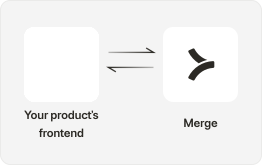
Products backend

Before your user Links, use Scopes in the Dashboard to configure what information Merge and your app is able to access from a third-party platform.

2. Access opportunity data

Your app is able to get the data it needs with the Opportunity Model.

You can track the status of the Opportunity with the Status field, with values such as “Won.”
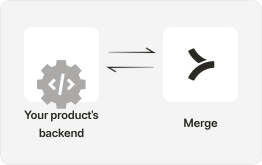
Backend interact with Merge

Merge supports Webhook Emitters and Receivers for certain CRMs, such as PipeDrive and HubSpot. You can configure these webhooks to send your app real time updates about deal changes.

3. Configure notification logic

In your application, configure the relevant logic to send a notification to your users’ selected channel, such as Slack or Teams.
Backend interact with Merge

4. Improve sales efficiencies

Your app can now offer sales performance and metric tracking, helping your users and their teams improve their deal velocity.
Products frontend
Get started automating CRM flows with Merge

Integrate today or talk to our sales team to learn how Merge unlocks hundreds of integrations in days - not years.


Get a demo